
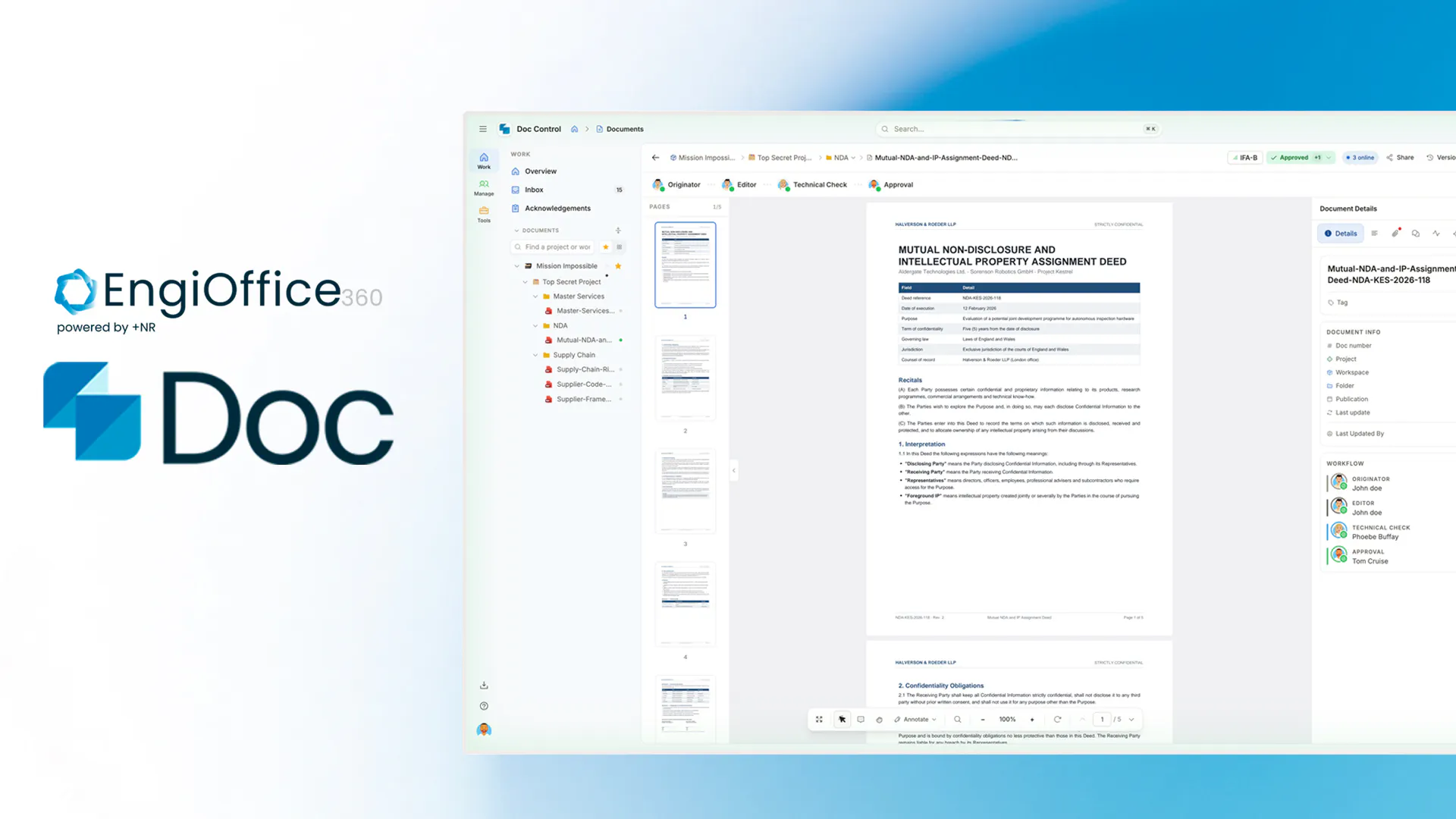
+NR is launching EngiOffice360 (EO360) Doc, the document control system it built for its own engineering contracts. Every revision carries a name, a date and a time. The AI that reviews those documents can run through vetted third-party providers or installed on your own infrastructure, depending on what each application requires, and your documents are never used to train anyone's models. And it was designed to be used by everyone who touches a document, from the fitter on the shop floor to the investor reading the board pack.
Ask any project team which version of the procedure is the current one.
If the answer starts with "let me check with someone", the company does not have control of its documents. It has luck. And luck is not an information management system.
We know that answer well, because we have heard it on our own projects and in conversations with clients. On a project in 2023, while we were trying to normalise the documentation, version control was whatever suffix the file name carried: old, new, v1, v2 and the dangerous _oficial, all living together in a generic repository. A rev C on the repository, a rev D in an inbox, and nobody was able to say which one the welder used. The file name had quietly become the version control system, and file names do not record who approved anything.
That is the problem EO360 Doc was built to end. Today we are opening it to companies outside +NR.
What weak document control actually costs
The cost is real, it just never appears as a line in the budget. It shows up as rework, delay, penalty and, occasionally, as something far worse.
One day a week, per person. That is how much time knowledge workers spend looking for information that should have been at hand (McKinsey Global Institute).
US$ 88 billion of rework in a single year, globally, caused by decisions made with bad data in construction alone (Autodesk / FMI, Harnessing the Data Advantage in Construction, 2021).
2.7 times. Non-compliance costs an organisation roughly 2.7 times what it costs to stay compliant in the first place (Ponemon Institute).
96% of workers report struggling to find the latest version of a document (M-Files, Global Intelligent Information Management Benchmark). Nearly all of us are in that number.
Then there is the part that does not fit in a spreadsheet. The Grenfell Tower inquiry spent years reconstructing what had been tested, certified and signed. The World Health Organization has linked more than 300 child deaths since 2022 to contaminated cough syrup that moved through a supply chain on paperwork nobody could verify. When a door plug separated from a 737 in flight, the NTSB found no record of the removal and reinstallation that preceded it.
Different sectors, and the same failure: not a missing engineer, a missing record.
Traceability is a discipline, not a folder
The market has been getting this part wrong for years, and not for lack of tools.
Google Drive and SharePoint answer one question very well: where does the file live. They even keep an edit history. What they do not give you, without building flows and policies on top, is the second answer, the one that decides audits and lawsuits: who wrote this, who checked it, who approved it, when, and against which revision.
The vertical platforms do answer it. They also lock you into one sector's workflow and price accordingly, which is why they rarely make it past the engineering department and into quality, legal, procurement or HR, where the same problem exists in exactly the same shape.
Traceability is not storage. It is a discipline. Every document needs an author, someone who checked it, someone who approved it, and a date when it expires. And each of those signatures is stamped in time, with no way to rewrite it later without leaving a trace. Almost every organisation pushes that discipline to later, as if it were paperwork getting in the way of the real work. We have seen it play out the other way: two years on, that paperwork was exactly what decided whether the work could be defended at all.
How EO360 Doc works
Three moments of the same document, recorded, in order.
The approval workflow is yours to design. Author, verification and approval, each step with a name, a date and a time. A three-step engineering flow and a two-step HR flow live in the same system without either being forced into the other's shape.
Nobody changes tools. The file leaves the system, is edited where it has always been edited, and comes back as the next revision. There is no new editor to learn and no migration project to justify to a board. The teams that resisted every previous system stay in the software they already know.
Every revision keeps its history. Not the last state of the document, the whole path to it. When the auditor, the client or the lawyer asks who approved something, the answer is a record, not a search through old emails.
It runs as a subscription, in the cloud or on your own server, and serves any sector. Nothing in it assumes mining, oil and gas or manufacturing, because document control does not change when the industry does.
AI that reads your documents following your data policy
Version control is the floor, not the ceiling. The part we care most about is what happens on top of it.
Every company today faces the same bad trade. Use AI on your technical documentation and accept that your procedures, calculations, contracts and drawings pass through infrastructure you do not control. Or refuse AI, stay slow, and watch competitors review in hours what still takes you a week. Neither answer is acceptable when the material in question is the accumulated engineering knowledge of the company.
EO360 Doc treats this as an architecture decision, not a factory default. The AI layer can run through established third-party providers, under agreements that keep your content out of model training, or embedded on-premise, installed on your own servers, when the application demands it. Which of the two makes sense is assessed case by case, together with your team. In both scenarios, the engineer gets assistance and the company keeps the knowledge.
What that assistance looks like in practice: when a revision comes back, the AI reads it against the previous one and points out what changed, so the reviewer opens the document already knowing where to look, instead of comparing forty pages by eye at eleven at night (not a figure of speech). Inconsistencies surface early, when they still cost a correction rather than a rework order.
And then it stops. The AI reviews, the human signs. Approval is a deliberate act by a person with a name, a role and accountability, and no automation touches it. That line is not a technical limitation, it is a design decision. In an audit, "the system approved it" is not an answer.
Being early here is not a marketing posture. The companies that will be using AI across their technical documentation three years from now are the ones settling the security question today, before the first leak turns it into a board-level crisis.
From the shop floor to the boardroom
A control system only works if the people closest to the work actually use it. That is where most of them die, in the gap between what the quality department bought and what the shop floor tolerates.
So the system was designed for very different pairs of hands.
The operator and the fitter open the current revision of the procedure on the machine or on a tablet at the workface, without training, without hunting through folders, and with the certainty that what is on the screen is the version in force. If it is not in force, they cannot open it by accident.
The engineer and the supervisor work in the flow they already know, submit revisions, and see where each document is: with whom, since when, waiting for what.
The quality and legal teams get the evidence chain an audit requires, ready, without assembling it from inboxes the week before the auditor arrives.
The director and the investor see the state of the documentation itself: what is approved, what is pending, what has expired, and where a document is holding up a decision. Documentation stops being an act of faith in the middle management layer and becomes something you can look at.
Same document, same record, different door into it, depending on who you are and what you need from it.
Built inside a certified quality system
EO360 Doc did not come out of the lab. It came out of engineering contracts where the documentation had to survive client audits, and it was developed and is maintained inside +NR's ISO 9001:2015 certified quality management system, the same one that governs our engineering delivery.
That is the difference between a tool that talks about compliance and a tool built by a company that has to prove it. The document control requirements we designed against are the ones our own auditors apply to us. Before it was a product, EO360 Doc controlled the documentation +NR delivered under live service contracts, for clients in mining, oil and gas and heavy industry.
What comes next
We are opening the first round of pilots to three to five companies from different sectors, to put the system in real context rather than in a demo.
If document control in your organization still depends on someone remembering which file is the good one, that is the conversation to have with us. Fifteen minutes with our team, no sales deck.
Write to info@plusnr.com or reach us on WhatsApp at +351 924 875 118 (Portugal) or +55 12 99764 0447 (Brazil).
Next time somebody asks which version is the right one, nobody should have to answer.